Showing posts with label Beppu. Show all posts

Monday, 10 June 2013

Here and there

So here's some more photos from Furuichi and Sekinoe on June 4th, the same day that I took photos of the Oriental Reed Warblers in the post below. There were not many birds in the fields. I didn't find any painted-snipe, but instead I came across a pair of shy Ruddy-breasted Crakes in Sekinoe and another juvenile in Furuichi. A nesting pair of Common Kingfisher was seen flying in and out of the nest hole in Furuichi with food for the chicks. It is the first Common Kingfisher's nest I've ever seen. However, they would always fly directly in and out of the hole without stopping to perch on any branch, so it was impossible to get any good shot.

Shy Ruddy-breasted Crake

Stretching its wings

Almost perfect!

Juvenile Ruddy-breasted Crake

Looking cute with its tail cocked up

Probably a Reeve's Pond Turtle (Kusa-game meaning Grass Turtle in Japanese)

Another Reeve's Pond Turtle

Common Map Butterfly

Swallowtail Butterfly
Since there were not many birds, I spent my time taking photos of butterflies and turtles in and around the lotus fields. There were some interesting butterflies like the Common Map and Swallowtail. I didn't expect to see a Common Map in Japan though, since I thought it is only found in the southern hemisphere.

Apart from the stuff in Furuichi and Sekinoe, on the afternoon of May 29th I saw a flock of about 20 White-throated Needletails swifting right over my campus. I hurried back to get my camera but as soon as I arrived back in the campus, they were already super high up in the sky. At least, I could get some record shots to prove the existence of this incredible swift in Beppu.

White-throated Needletail

Flock of White-throated Needletails

Sunday, 9 June 2013

Oriental Reed Warbler

I went to Furuichi area again on June 4th to look for the Greater Painted-Snipe chicks but failed to find any. The lotuses in the fields have become much too tall for me to see any bird. So instead I turned my attention towards the loud Oriental Reed Warbler which was singing from the rooftop!

Singing male Oriental Reed Warbler


It was really owning the stage!
There were several male birds in Sekinoe and Furuichi area but the one in these photos was the most approachable one. However, it still wouldn't allow me to get close to it even while singing, so these photos had to be pretty heavily cropped, except for the one on the pole. After taking photos of it for a while, I realised that there was also another bird hopping quietly the nearby reeds. Sometimes the singing bird would go into that same area where the other bird was staying too, so I decided to go and check out that patch of reeds. Turned out, the quieter bird was busy building the nest. It was the first time ever for me to see a reed warbler's nest. It was cup-shaped, made of tiny sticks, leaves and filled with some cotton-like material. Hope to see some progress on this nest soon.

The quiet female with nesting material

The male coming back to the nest

Female bird at nest with nesting material

This is already the best view of the nest. It was located deep in the reed.

Thursday, 23 May 2013

Painted-snipe Family

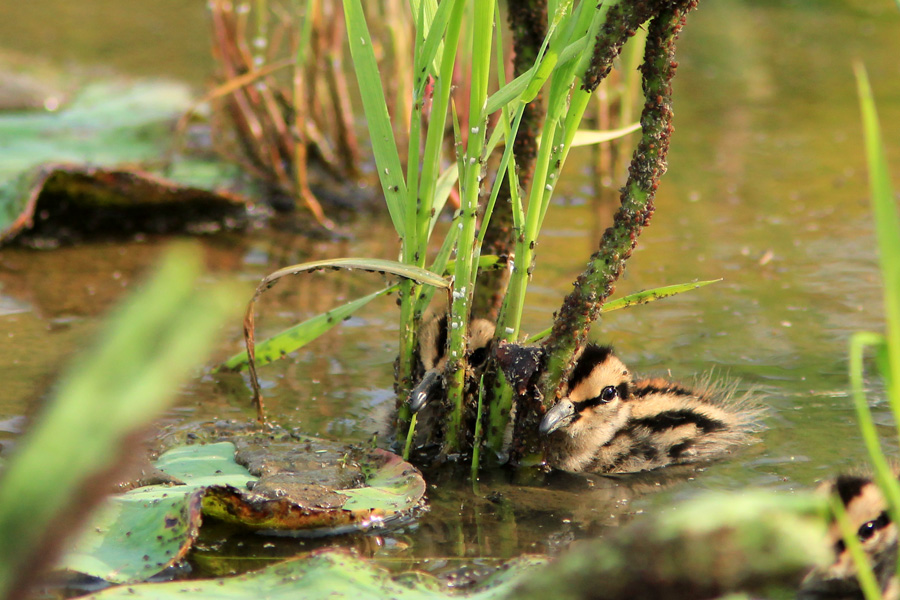
Last Saturday, I went out to Sekinoe and Furuichi area as usual. I first came across a pair of Greater Painted-snipes in an open field but couldn't get any decent photo because they decided to fly out too soon. Since it was quite an overcast and gloomy day, I guess that's why they were brave enough to come out to such an open area. Later at Furuichi, I spotted another male painted-snipe in its lay-low position as usual, but this time as I looked more closely, I found that there were actually 4 more tiny chicks lying beside it too!

Male Greater Painted-snipe with chicks


Aren't they just cute?


Even the chicks seemed to have mastered the patience skill. They just did exactly what the father was doing, sitting motionless hoping that I wouldn't notice them. I took some photos of them then walked out to observe them from the distance. They began to move again after few minutes and when I walked back to take some photos, they just immediately returned to the same lay-low position, so I took few more photos and left the area. Below are photos of the painted-snipes pair I found earlier at Sekinoe.

You might wonder what are those clumps?

They're Greater Painted-snipes!

Tuesday, 21 May 2013

Kyushu's Problem

While birders in the northern parts of Japan enjoy breathtaking views of colourful summer migrants like flycatchers and robins, here in the south, it is always either the forest is way too dark or the birds are just not cooperative. After taking photos of the Japanese Hare in the earlier post, I walked up hill to Otobaru Waterfall. Along the way, I came across a pair of Narcissus Flycatchers which seemed to be nesting somewhere up on the slope. The female was repeatedly coming back with food in its mouth and the male was doing look-out while giving soft high-pitched call constantly. Believe me, below are already the best shots I could get.

Male Narcissus Flycatcher

Male birds in spring show bright orange throat.

Close but definitely not a nice angle
While photographing the Narcissus, I heard a loud bird singing just above my head and it was a male Blue-And-White Flycatcher, another common species that's really difficult to photograph in Kyushu or at least, Beppu. It didn't care much about me taking photos of it with flash but it just kept perching up there on the higher branches.

A more showy but never came down to lower branches, Blue-And-White Flycatcher

It was singing so loudly and aggressively.

Really never came down
Eventually, it got much too dark for me to take any photo, so I decided to walk back. Along the way, there was a small group of Varied Tit fledglings with their parents feeding in the bamboos. I think it's the first time for me to see young Varied Tit. I actually thought they were Coal Tits when I first saw them with bare eyes. Other birds found along the way included several Japanese Green Woodpeckers, a super shy species which I can never get a decent shot of, some calling Chinese Bamboo Partridges, several Ryukyu Minivets which kept flying over my head with their loud high-pitched call, and a pair of Grey-capped Greenfinches.

One of the Varied Tit fledglings

Male Grey-capped Greenfinch

Japanese Green Woodpecker, another species which I can never get a decent photo.

Japanese Hare

This afternoon I went out to Rakutenchi area in search of the recently seen Japanese Paradise-flycatcher. I met Furuso-san who saw the bird earlier last week. She told me that she didn't hear the paradise-flycatcher for several days now, so probably it had already gone. I spent the whole afternoon waiting and searching but ended up not seeing any. Instead, I had quite a nice time with a surprisingly tame Japanese Hare. I first came across it while walking up hill. It was standing on the roadside and quickly jumped into the bush as I showed up. I decided to sit and wait for a while and after about 5 minutes, it popped up again from the bush!

Japanese Hare


Slowly coming out of the bush
It was a pretty busy path as several people came walking by and flushed the hare away, but after 3-5 minutes, it would come back out again and again. Later on, it seemed to recognise me as part of the scenery and came out to the road showing its full body. I then realised why it kept coming back to the same spot when it began eating some fresh leaves on the roadside. It looked so cute and funny when crunching the leaves in its mouth.


Then I knew the reason why it kept coming back, the food!


Japanese Hare carcass near my dorm

This was the first time for me seeing this cute animal alive. I didn't expect to be able to see it at all, especially with such a perfect view like this. I've come across a pretty freshly killed carcass once while walking down hill from my dorm and I thought that would be my only encounter. Back in Thailand, I've come across a Burmese Hare once, alive and well, but it was 5 in the morning, completely dark and the hare quickly jumped away as soon as my headlamp shone on it, so I kind of had that impression of how a wild hare should be like. Surprisingly, this Japanese counterpart proved me wrong.